












RVing from 1921 to 1930
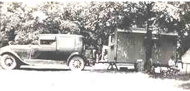
1923, Tourists' Camp in Orillia
Source: National Archives of Canada
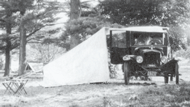
1923, America First camper
Photo courtesy: Atlas Mobile Home Directory
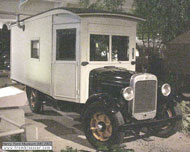
1923, Nomad House Car
Photo courtesy: www.trombinoscar.com
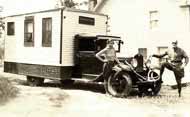
Classic example of a motor
Source: unknown
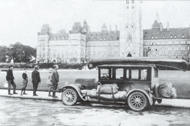
1925, American Tourists in Ottawa
Source: National Archives of Canada
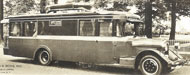
1927, Flordellen
Photo courtesy: Jim Holzschuh
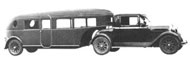
1928, Curtiss Aerocar
Source: Smithsonian Magazine
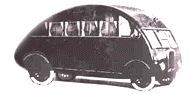
1928, Road Yacht
Photo Courtesy of
Atlas Mobile Home Directory
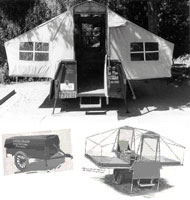
1928, Gilkie Tent Trailer
Source: Unknown
Up until the 1920s, the campers were custom built. In the 1920s, several manufacturers built bodies, which could be mounted on auto chassis to create house cars. These bodies were sold and shipped to the purchaser to be mounted on Model T or other car chassis. In the 1920s, Ford Model Ts were by far the most common make of automobile.
In Orillia, Ontario this photo of a two-wheeled wooden trailer was taken showing front and back legs and hookups.
This American First homemade motorhome from 1923 is built on a Chevrolet chassis. Owners of first campers usually gave them names. Words "America First" are painted on the sides of the camper. The camper body is made of wood.
The Nomad house car, from 1923, was added to the Ford TT chassis. Note the chimney and window shade on roller.
This fantastic picture of American tourists in front of the Parliament building in Ottawa is a rare look at the RV lifestyle in the 1920s. Auto is a Franklin and carries a canoe on top and camping gear on running board and rear luggage rack.
In 1927 Leonard S. Whittier from Elmira, New York, had a custom built recreation vehicle, Flordellen. The car was 31' long, 9'2" high and 7' 6" wide and was built on a Brockway model "H" bus chassis. The master quarters had accommodations for two with a Pullman style bed, wicker chairs, wardrobe, bookcases, built-in radio system, spinet desk and ample storage space in the lockers and cupboard. The refrigerator and the sink were on one side of the kitchen, with the electric stove and water heater opposite. On the right side of the vehicle was a complete bathroom. There was a shower bath and a chemical toilet with a large septic tank beneath the floor.
In 1928, Glenn Curtis created the Aerocar Land Yacht. It was constructed on aircraft principles with a frame of light metal tubing braced by wire cables. It featured four berths, a galley, running water, servants quarters, multiple bathrooms and observatory cockpit with a glass roof.
The Road Yacht from 1928 was one of the first regularly produced motor homes in 1928 and had a great modern shape and look.
And then the 1928 Gilkie tent trailer, manufactured by E.P. Gilkison & Sons, Indiana. Camper features include: two 54" beds with sagless mattresses, large wire screen windows, waterproof, mildew proof army duck tent, rust proof metal drawer. On the road, the rig looked like a normal flat, two-wheeled trailer. When parked, two front and back telescoping legs were dropped into position and the rig was leveled. The tarp is removed. Two arches are then raised, one at the front and one at the rear. The sides's arms fold outward on each side of the trailer to hold the bed springs.
 Advertisement
RV History 
Did You Know 
Traffic lights were in use before there were motorcars when, in 1868, a lantern with red and green signals was used at a London intersection to control the flow of horse buggies and pedestrians.
When motorcars were introduced to the US in the late 1890s, police officer William Potts used railroad signals for street traffic, adding the amber light. His electric traffic lights were installed in 1920 in Detroit, Michigan, USA. They were manually controlled.
The first automatic traffic light was invented later in 1920 by Garrett Morgan and first used in Cleveland, Ohio, USA.