












RVing from 1911 to 1920
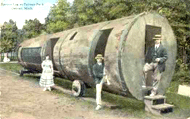
A unique 1912 model "trailer" made out of a large spruce log.
Photo courtesy: Atlas Mobile Home Directory
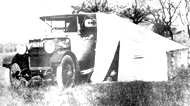
Tent mounted on one side of the car.
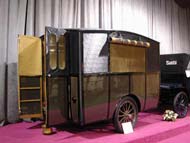
1913, Earl Travel Trailer
Photo courtesy: Yuriko Sasaki, Lee Export Co., Japan
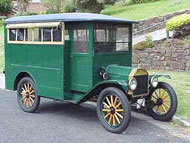
1915 Lamsteed Kampkar
Photo courtesy: Peter Kable, Australia
Source: www.mtfca.com
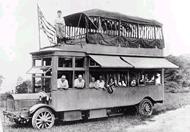
1915, Conklin's Gypsy Van
Source: Motor Magazine, 1990
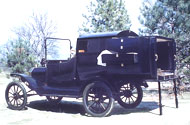
1916, Telescoping Apartment, David Woodworth.
Source: www.showspan.com
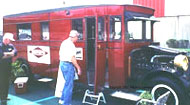
1917, Packard
Photo courtesy: www.RVFunTrips.com
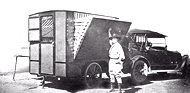
Tipout sides on a travel trailer
Photo courtesy: Atlas Mobile Home Directory
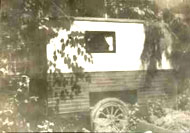
Two-wheeled wooden trailer from 1920
Photo courtesy: Atlas Mobile Home Directory
In this decade, campers continued to adapt their own vehicles and made house cars. We can find a wide range of equipment, from cars with rolled-up tent and storage boxes attached to the rear, to first travel trailers, fifth wheels or buses converted to motorhomes and home made motorhomes.
Wood was the principal material. For outer coverings and tents they used dust-proof, bug-proof and waterproof materials. These cars had bedrooms, kitchenette, water pump, wash basin, shower bath, chemical chamber, wardrobes, box spring and mattress, refrigerator, wicker chairs, window awnings, curtains, screens and shades, and other typical motorhome features.
Some of them were equipped with electric lights or had communication capabilities. A person could hook into a telegraph line and send a message.
The 1913 Earl Travel Trailer with a Ford Model T Runabout is believed to be the worlds oldest non-tent travel trailer. It was custom-built in Los Angeles and restored in 1980.
It is currently on display at the RV/MH Hall of Fame museum in Elkhart Indiana and is the property of Wade Thompson, Chairman of Thor Industries.
The Lamsteed Kampkar was invented by Samuel B. Lambert (the same Lambert Family of Listerine fame). It was advertised as the only practical and complete car for touring and camping ever devised. The Kampkar shell fit perfectly on a Ford chassis. The sides of the car folded down, in the fashion of a Pullman berth, and the seat and side cushions combined to make a bed 42 inches wide on each side of the car.
In 1915, August Fruehauf invented the concept of the fifth wheel.
In 1917, aviator Glenn Curtiss built a fifth-wheel camping trailer, he called "motor bungalow". The trailer was plywood over a spruce frame, and fairly spacious, with canvas tilt-out beds In 1928, he revamped his design and called it the "Aerocar Land Yacht".
1915, Roland and Mary Conklin's Motor Bus Company from Huntigton, N.Y., built the house car Gypsy Van for family travel experience. It was 25 feet and weighed eight tons. It had a homelike interior, modeled after English manor houses.
1916, San Francisco businessman, Gustau de Bretteville, designed and manufactured the "Telescoping Apartment". The Telescoping RV sits atop a Ford Model "T" Runabout. It was only 40 inches long and 54 inches wide. The back dropped down and then expanded to 76 inches to provide a bed large enough for two people. The camper featured a pantry about the size of a cardboard box, a chest of four drawers that pushed out on one side and stove which mounts on the engine. A portable shower used hot water from the engine.
The 1917 25 foot Packard bus converted to a motorhome. It was built by Earl C. Antony Shops, from Los Angeles. It has a bedroom at the rear with convertible sofas, storage, a small galley area, a kitchen with two burner gasoline cook top, ice box and sink, a toilet in a tiny closet and some communication capability - it could hook into a telegraph line to send a messages.
 Advertisement
RV History 
Did You Know 
Most cars per capita in the world belongs to Canada with one car for every two Canadians.